
Cultivating the land, producing crops, and rearing livestock are all parts of agriculture. It involves preparing plant and animal goods for human use and distributing them to marketplaces. The agriculture industry refers to the entire system involved in growing crops, raising livestock, and producing food, fibre, and raw materials. It includes farming, horticulture, livestock management, food processing, agricultural technology, supply chains, and agribusiness services. As a backbone of food security and global economies, it connects production with research, modern technology, and industrial support systems.
The agriculture industry is one of the most vital pillars of India’s economy. It feeds the nation, generates employment, and supports several industries through raw materials and allied services. In today’s rapidly evolving global market, agriculture and industry are more interconnected than ever, creating a powerful cycle of growth, production, and innovation.
In this blog post, more will be discussed on the agriculture industry.
Quick Glance For the Blog
Below is a concise, tabular overview that summarises the complete information on the Agricultural Industry, including courses, skills and career options in a structured and easy-to-read format. In short, it is a summarised version of the information provided in the blog.
| Particular | Details |
|---|---|
| What is the Agricultural Industry? | Sector involved in food and crop production for human use |
| Key Activities | Crop farming, Livestock rearing, Fisheries, Dairy, Poultry, Beekeeping, Nursery/greenhouse farming |
| Supporting Industries | Seed suppliers, Fertiliser companies, Farm machinery manufacturers, Irrigation, Agritech services |
| Major Products | Milk, pulses, spices, wheat, rice, cotton, fruits, vegetables, sugarcane, tea, and fish. |
| Economic Importance | Ensures food security, rural employment, supply chain growth, and rural industrialisation. |
| Major Government Initiatives | PM Matsya Sampada Yojana, PM Kisan SAMPADA Yojana, Steel Silo Action Plan |
| Interdependence Between Agriculture & Industry | Production Linkage
Demand Linkage Savings & Investment Linkage |
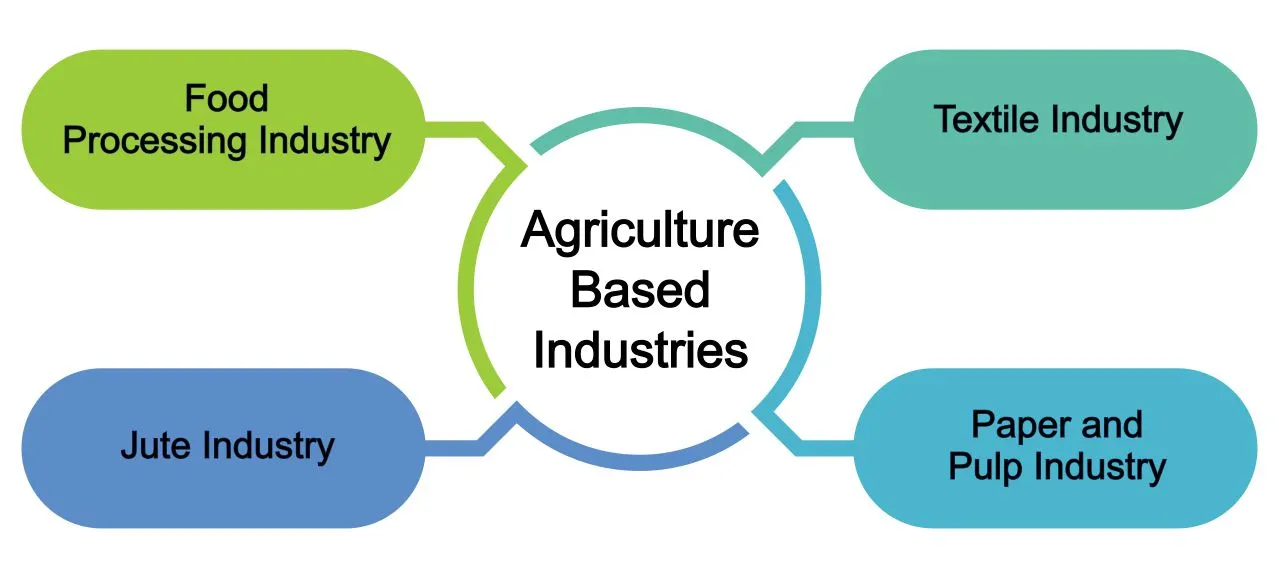
| Agriculture-Based Industries | Food Processing Industry, Jute Industry, Textile Industry, Paper & Pulp Industry |
| Career Opportunities | Agricultural Officer, Agronomist, Soil Scientist, Farm Manager, Food Quality Analyst, Agribusiness Manager, Irrigation Specialist, Agricultural Extension Officer, Crop Production Manager, Supply Chain & Procurement Executive (Agri), Precision Agriculture Technician (Drones, IoT, Sensors) |
What is Agricultural Industry?
Businesses and enterprises engaged in the production of food or crops for human use comprise the agricultural industry. Businesses in this sector focus on crop cultivation and animal husbandry. The animal production sector includes aquacultures (fish and seafood farms) and apiaries (bee farms) in addition to the conventional cattle, dairy, poultry, or pork farms. In a similar vein, plant production includes field crops like cotton and tobacco as well as greenhouses, nurseries and food crops. Although agriculture has been practised for thousands of years, its production methods have continuously evolved, making it both an ancient and modern sector.
The businesses that supply seeds, agricultural equipment, and other products and services that have contributed to the agriculture sector’s increased productivity and efficiency throughout time are also a part of the agriculture industry.
Also Read: Govt jobs after bsc agriculture salary & More Career Options
Agriculture Industry in India
Present State
Nearly 55% of Indians make their living from agriculture. India leads the world in agricultural output and has the second-largest agricultural land area.
The nation is the world’s largest producer of milk, pulses, and spices. Besides, our country has the largest cattle herd (buffalo). In addition to all this, it has the largest area planted to wheat, rice, and cotton. Its crucial position in the world’s food supply is further highlighted by the fact that it is the second-largest producer of fruits, vegetables, tea, farmed fish, cotton, sugarcane, wheat, and rice.
India’s food sector is expected to expand quickly due to its enormous potential for value addition. In terms of production, consumption, exports, and development potential, the food processing sector alone accounts for 32% of the nation’s overall food market and is ranked fifth internationally.
In addition to providing jobs for millions of farmers, the industry is essential to food security, supply chain expansion, and rural industrialisation.
Major Investments and Developments
The following are some major investments and developments in the agriculture industry:
- 95% of India’s agricultural and processed food exports, including marine items. They are eligible for duty-free access under the Free Trade Agreement with the United Kingdom. This agreement was signed on July 24, 2025. It is anticipated to increase agricultural exports by more than 20% in three years. It is supporting the country’s goal of $100 billion in agricultural exports by 2030.
- Due to growing demand for precision agricultural technology, the smart agriculture market in India is expected to reach Rs. 6,033 crore (US$714.1 million) in 2024 and rise at a compound annual growth rate (CAGR) of 20.54% to Rs. 33,325 crore (US$3,837.6 million) by 2033. It is anticipated that US$30–35 billion will be invested in Indian agritech enterprises by 2025.
Major Government Initiatives
- In order to improve safety and governance, the Coastal States Fisheries Meet 2025 under PM Matsya Sampada Yojana in July 2025 allocated Rs. 255 crore (US$29.1 million) for infrastructure and Rs. 364 crore (US$41.6 million) to equip 1,00,000 vessels with transponders. Additionally, the Marine Fisheries Census 2025 and the Regional Fisheries Management Councils.
- Through 1,601 projects, the Pradhan Mantri Kisan SAMPADA Yojana (PMKSY) is boosting India’s food processing industry, helping 34.15 lakh farmers and generating around 4.33 lakh jobs.
- With a total capacity of 24.25 lakh metric tonnes (LMT) under construction, the government has authorised an action plan for building steel silos under a public-private partnership (PPP) model to modernise storage facilities.
- A budget of Rs. 1.52 lakh crore (US$18.26 billion) was allocated for agriculture and related sectors in the Union Budget 2024–2025.
Interdependence Between Agriculture and Industry
According to economists, there are three primary kinds of linkages between agriculture and other industries. If any one of them is removed, then the entire interdependence between them will become unstable.
Production Linkage
It is the most well-known relationship between agriculture and other industries. The main source of raw materials that companies sorely require to operate is agriculture. Think about the edible oil industry. Without mustard, sunflower, or soybean farming, oil refineries would become non-functional plants with expensive machines having zero output.
The intriguing thing about this relationship, though, is that quality is equally as important as quantity. Farmers are forced to improve their farming methods as a result of the more sophisticated industry’s demands for higher-quality raw resources. For example, a rice mill that processes premium basmati rice would pay farmers much more for grain that satisfies certain quality requirements.
Demand Linkage
Agriculture gives a boost to the industrial sector, but the opposite flow is just as significant. Industries supply agriculture with the equipment, supplies, and technology required for contemporary farming. Agriculture is transformed from a traditional activity into a contemporary, effective system by this demand relationship.
This link is best shown by the fertiliser business. The nitrogen, phosphorus, and potassium chemicals that have transformed agricultural yields globally are produced by chemical corporations.
Another important demand relationship is agricultural machinery. Agricultural demand is essential to the survival of tractor manufacturers, irrigation equipment manufacturers, and harvesting machinery manufacturers. The market for these businesses is expanding as farms become increasingly mechanised and buy more industrial goods.
Savings and Investment Linkage
The flow of savings and investments between agriculture and industry is arguably the most subtle but no less significant relationship. While prosperous companies may supply funds for agricultural enhancement, successful agricultural regions frequently produce excess revenue that can be invested in industrial development.
Agricultural surpluses have historically been utilised by several nations to finance their early industrialisation. Agricultural taxes and profit extraction provided funding for industrial undertakings throughout India’s early stages of growth. Rich farmers frequently put their earnings into small businesses or buy stock in larger businesses.
On the other hand, through contract farming agreements, when businesses engage in agricultural output to assure their raw material supply, industrial earnings can occasionally return to agriculture. For instance, food processing businesses frequently give farmers seeds, fertiliser, and technical assistance in return for guaranteed crop purchases.
All of these linkages show how agriculture gives a boost to the industrial sector, and in return, industries support and strengthen agriculture.
Agriculture Based Industries
After understanding the interdependence of agriculture and industry, let’s discuss agriculture based industries that are:
Food Processing Industry
Any raw product from agriculture, dairy, animal husbandry, meat, poultry, or fishing is transformed through a process (involving workers, power, machinery, or money) so that its original physical properties change and the transformed product has commercial value and is suitable for human and animal consumption. This process is known as food processing.
In order to effectively preserve food ingredients and improve their shelf life and quality, it also involves the process of adding value to goods through techniques including drying, adding food additives, and preservation.
The Food Processing Industry (FPI) is extremely important because it fosters linkages and synergies between the two economic pillars, industry and agriculture. Below are some points that will give a proper explanation:
- Employment Creation: By serving as a link between agriculture and manufacturing, it creates both direct and indirect job possibilities.
- Doubling of farmers’ income: As the demand for agricultural products rises, so will the prices given to farmers, boosting their earnings.
- Decreased malnutrition: The population’s nutritional deficit can be closed by fortifying processed meals with vitamins and minerals.
- Boosts Trade and Earns Foreign exchange: It is an important source of foreign exchange. For e.g., Indian Basmati rice is in great demand in Middle Eastern countries.
- Curbing Migration: Food processing, being a labour-intensive industry, will provide localised employment opportunities and thus will reduce the push factor in source regions of migration.
Jute Industry
One of India’s most significant fibre crops, jute is valued both economically and for its many uses. It is prized for its affordability, softness, and strength and is widely utilised in the production of goods including gunny bags, ropes, carpets, and tarpaulins. This jute industry is vital to India’s economy.
The following points show its economic importance:
- Important Revenue Generator: It contributes significantly to the GDP of India’s agricultural sector and is one of the country’s most important crops. The economic stability of the areas where it is grown is bolstered by its importance as a cash crop.
- Assistance to Associated Industries: This industry produces tarpaulins, carpets, ropes, and gunny sacks, among other goods. Rural economies and industrial activity are strengthened by this relationship.
- Potential for Export: India is a major supplier of jute goods, which are highly valued on global markets. This export potential promotes trade balances and strengthens the national economy.
- Opportunities for Employment: Millions of people, including farmers, labourers, and workers in the processing and manufacturing industries, benefit directly and indirectly from crop cultivation. For rural economies, this broad employment is essential.
- Stability of Income: It offers financial stability as well as economic security and is a major source of income for many farmers, especially in areas that cultivate jute.
- Enhanced Livelihood: By providing a reliable source of income, supporting rural development, and boosting general economic well-being, crop cultivation raises the level of living for agricultural communities.
Textile Industry
The manufacture, distribution, design, development, and research of textiles, fabrics, and apparel are all included in the textile industry.
These days, the textile industry is a worldwide phenomenon that includes all companies engaged in the creation, production, manufacture, and distribution of textiles. These days, the sector is quite complicated as well. It begins with agriculture, with the production of fibre, the raising of sheep and silkworms, and the mining of minerals and metals. These fibres are then processed to create yarns, textiles, and clothing. Mills for spinning, weaving, knitting, dyeing, and clothing fall under this category. This industry also includes businesses that offer buttons, zippers, knitting materials, sewing machines, threads, laces, looms, and drapery hardware.
Paper and Pulp Industry
The pulp and paper industry is a significant sector that uses raw resources, including wood, recycled fibres, and other plant matter, to produce pulp and paper goods. These ingredients are transformed into pulp, a fibrous substance, which is then pressed and dried to create goods like paper, paperboard, and tissue. It is a sizable worldwide industry that boosts jobs and the economy by producing a variety of goods.
Till now, we have covered every major aspect of the agriculture industry. Beyond supporting farmers and strengthening the country’s economy, this sector also unlocks a wide range of career opportunities, such as:
- Agricultural Officer
- Agronomist
- Soil Scientist
- Farm Manager
- Food Quality Analyst
- Agribusiness Manager
- Irrigation Specialist
- Agricultural Extension Officer
- Crop Production Manager
- Supply Chain & Procurement Executive (Agri Sector)
- Precision Agriculture Technician (Drones, IoT, Sensors)
Why K.R. Mangalam University (KRMU) for Agriculture Studies?

To secure the best career opportunities in the agriculture industry, students need a strong, industry-focused education—and this is where K.R. Mangalam University (KRMU) stands out. KRMU offers modern, experiential agriculture programmes that blend scientific knowledge with hands-on training, fieldwork, and agritech exposure.
- Industry-relevant curriculum prepared in collaboration with leading professionals and experts.
- State-of-the-art infrastructure featuring smart, air-conditioned classrooms, advanced program-specific labs, a digital library, and Wi-Fi throughout the campus.
- 100% Placement assistance to students, with the highest being 56.6 LPA.
- Dedicated and Experienced faculty who strive to provide consistent mentorship and guidance to students.
Conclusion
The agriculture industry is evolving rapidly, creating vast opportunities for skilled professionals across farm management, agribusiness, research, technology, and supply chain roles. Understanding how agriculture and industry depend on each other is essential for anyone aiming to build a strong career in this sector.
By providing cutting-edge, industry-focused agricultural education that gives students real-world experience, scientific knowledge, and practical skills, organisations like KRMU enable students to confidently enter the agriculture industry.
Also Read: Guide On KRMU’s B.Sc. Agriculture Admission
FAQs
What is agriculture industry?
The agriculture industry includes all activities related to growing crops, raising livestock, food processing, distribution, and the technologies that support modern farming.
Why is the agriculture industry important in India?
Agriculture is the backbone of India’s economy, providing employment to millions, supporting food security, and supplying raw materials to major industries.
How does agriculture give a boost to the industrial sector?
Agriculture supplies essential raw materials to factories, increases demand for industrial goods like tractors and fertilisers, and supports rural markets.
What are agriculture-based industries?
Industries such as dairy, sugar, jute, textiles, food processing, fertiliser, and edible oils that rely directly on agricultural raw materials.