


B.Pharm., or Bachelor of Pharmacy, is a well-known undergraduate academic degree in the field of medical science. The popularity of this degree is because it serves as the foundational qualification for various careers, especially as a pharmacist. Its curriculum provides students with in-depth knowledge of various things related to medicines. They include drug discovery, synthesis, testing, safety, efficacy, and the appropriate use of medications. The programme integrates various B Pharmacy subjects, including Chemistry, Biology, Pharmacology, and Physiology. All of the coursework prepares graduates to work in a variety of healthcare settings.
In this blog post, we will discuss B Pharmacy subjects and other aspects of this programme. All of this will give you proper B Pharmacy information and how many subjects are in B Pharmacy.
Duration of B Pharmacy
While searching for the best B Pharmacy course, aspirants usually search “B Pharmacy how many years”. A Bachelor of Pharmacy degree takes four academic years divided into eight semesters. For students who enrol through a lateral entrance, the duration of B Pharmacy course is three years divided into six semesters. During these durations, all the below-mentioned B Pharmacy subjects are covered.
What are the Subjects in B Pharmacy?
Below are the B Pharmacy main subjects:
| Subjects | General Descriptions |
|---|---|
| Pharmaceutical Chemistry I |
|
| Anatomy and Physiology of Human Body |
|
| Biochemistry |
|
| Pharmacognosy I |
|
| Pharmaceutical Microbiology |
|
| Pharmaceutical Mathematics |
|
| Pharmacy Dispensing |
|
| Pharmaceutical Chemistry II |
|
| Pharmacology 1 |
|
| Pharmaceutics I |
|
| Pharmacognosy II |
|
| The Law of Pharmaceuticals |
|
| Community Pharmacy and Health Education |
|
| Pharmacology II |
|
| Pharmaceutics II |
|
| Pharmacokinetics and Biopharmaceutics |
|
| Pharmaceutical Analysis |
|
| Clinical Pharmacy |
|
| Medicinal Chemistry |
|
| Pharmaceutical Technology |
|
| Pharmacovigilance |
|
| Regulatory Affairs |
|
| Research Methodology in Pharmacy |
|
| Industrial Pharmacy |
|
So, these were the key B Pharmacy subjects. Other than these subjects, B Pharmacy students must do a 6–8 week internship at a community pharmacy, hospital, or pharmaceutical corporation. They can use their knowledge and hone their professional abilities via hands-on experience in a variety of pharmaceutical environments.
Also Read: After B Pharmacy Which Course Is Best To Pursue In 2025
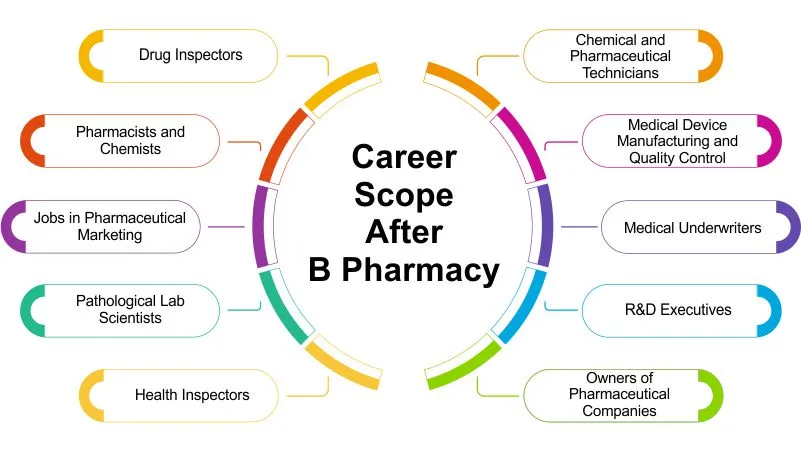
There are lots of career opportunities after getting the B Pharmacy degree. The following are the prominent ones:
Drug Inspectors
Graduates of the B.Pharm programme may be hired as drug inspectors. Drug inspectors are in charge of ensuring that any new medication complies with the necessary quality, safety, and efficiency criteria from the time the medicine is being developed until the finished product is produced. Drug Inspector positions offer excellent career prospects and are filled through UPSC and SSC examinations.
Competitive tests and direct absorption based on graduation merit are part of the recruiting procedure. After earning a B.Pharm, being a drug inspector is a great career choice because it’s one of the most sought-after jobs in the pharmaceutical industry.
Average Annual Income Range (In Rs): 8 lakh – 15 lakh
Pharmacists and Chemists
Another career option for B.Pharm grads is to work as a pharmacist and chemist. They play a crucial role in dispensing medications and managing medical supplies as per a doctor’s prescription. They also guide patients on correct dosage, timing, and potential side effects, including drug interactions.
Pharmacists work across retail pharmacies, hospitals, pharmaceutical sales, marketing, and private clinics. With opportunities in reputed organisations and healthcare setups, becoming a chemist after B.Pharm is a practical and rewarding career path.
Average Annual Income Range (In Rs): 2.5 lakh – 6 lakh
Jobs in Pharmaceutical Marketing
By encouraging physicians, medical experts, and associated institutions to promote and utilise their prescriptions and medications, the representative serves as a grassroots connection for the firm to expand the scope and sales of their products.
They serve as the company’s public face and are crucial to achieving its financial objectives and promoting its goods and vision to customers. The key elements that advance a medical representative’s career are knowledge of the subject, communication abilities, affability, and networking proficiency. Employees are required to travel regularly to meet new clients in their early years as medical representatives.
Average Annual Income Range (In Rs): 3 lakh – 10 lakh
Pathological Lab Scientists
To diagnose and study diseases, pathological lab scientists carefully and repeatedly examine organs, tissues, fluids, and cells. It should be mentioned that this discipline requires a great deal of self-control to repeat different lab tasks in order to achieve long-term objectives. Typically, pathologists work as scientists, investigators, diagnosticians, and even educators. It is a desirable career option following a B.Pharm, with respectable salaries and reputations contributing to the attraction of positions.
Average Annual Income Range (In Rs): 2.5 lakh – 6 lakh
Health Inspectors
Upholding the numerous hygienic standards established by the state for establishments and enterprises such as restaurants, nursing homes, hospitals, childcare centres, and schools is the responsibility of a health inspector. After earning a B.Pharm, it is a prestigious and profitable professional choice.
In order to enforce the necessary hygienic standards and remove any potential threats, health inspectors do routine inspections at various institutions while working directly and locally for the state government. They work desk jobs and do on-site inspections.
They are in charge of responding appropriately to legitimate complaints in order to prevent health risks such as parasite infections, animal bites, bug bites, and sewage overflows.
Average Annual Income Range (In Rs): 8 lakh – 10 lakh
Chemical and Pharmaceutical Technicians
Chemical technicians work in labs or production facilities. Their job is to conduct experiments and analyse chemicals and data. These professionals help the engineers with a variety of testing and chemical processes.
They are also responsible for making sure the lab’s equipment is operating correctly, troubleshooting it, and creating reports on the tests that are carried out. A profession as a drug technician requires strong analytical and observational abilities.
After earning their B.Pharm, graduates who are drawn to the practical side of the pharmaceutical sector and possess a thorough understanding of lab safety are likely to pursue careers as chem technicians.
Average Annual Income Range (In Rs): 8 lakh – 10 lakh
Medical Device Manufacturing and Quality Control
B.Pharm graduates are frequently hired by pharmaceutical companies to oversee day-to-day operations and maintain formulation quality.
Employees with a B.Pharm in this field typically pursue further education and employment since higher opportunities in this field become accessible more quickly with more qualifications.
Experienced B.Pharm graduates are posted as industrial chemists after obtaining a higher degree.
Average Annual Income Range (In Rs): 10 lakh – 12 lakh
Medical Underwriters
Medical underwriters offer chances to work as medical scribes, medical transcriptionists, or even coders, departing from the conventional professional alternatives offered to B.Pharm graduates. There are also opportunities to work as a writer who creates medical documents or manages information pertaining to medical insurance.
Although the position requires understanding of anatomy, pharmacology, and medical terminology, candidates should anticipate gaining a fair amount of experience in the sector prior to earning high salaries.
A medical underwriter is a good career choice for individuals who want to work in a somewhat unconventional field after earning a B.Pharm.
Average Annual Income Range (In Rs): 2.5 lakh – 7 lakh
R&D Executives
Almost all pharmaceutical corporations are involved in an arms race to create new and improved treatments and therapies for the many illnesses and ailments that are common in society. Therefore, pathologists, researchers, technicians, scientists, etc. are obviously needed by these firms.
Executives in research and development are needed to make sure the program follows the specified timetables and standards. For graduates who are capable of handling leadership and managerial responsibilities in the future, this is a post-B.Pharm employment choice.
Along with other R&D managers, R&D executives will be in charge of doing research, creating new programmes, and managing current ones.
Average Annual Income Range (In Rs): 5 lakh – 8 lakh
Owners of Pharmaceutical Companies
Graduates with a B.Pharm who want to aim high can start their own pharmaceutical business. Their business can be creating novel drugs, supplying approved ones under their own brand.
Many people cannot afford the large initial investments that are needed to run a pharmaceutical firm. But graduates with advantageous circumstances can leverage their greater understanding of the industry to help their business succeed.
Average Annual Income Range (In Rs): Highly varies
*Note: The incomes mentioned above are sourced from various sources on the internet. Hence, they can vary.
Higher Education After B Pharmacy
Pharmaceutical courses are in high demand due to the wide range of lucrative career opportunities the industry offers. After completing B.Pharm, graduates can pursue several postgraduate and paramedical programmes to specialise further. Some popular options include:
- M.Pharm (Master of Pharmacy) – Highly standard progression
- Pharm.D (Post Baccalaureate) – A 3-year option after B.Pharm
- Diploma in Clinical Research – Popular for entering clinical trials
- Diploma in Drugstore/Pharmacy Management – Recognised in retail and hospital pharmacy
- MBA in Pharmaceutical Management – Widely offered and industry-relevant
- PG Diploma in Clinical Trial Management – Common for CRO roles
- MSc in Pharmaceutical Chemistry / related specialisations – A valid route towards research roles
- PG Diploma in Pharmacy Practice & Drugstore Management – Offered by several institutes
Knowledge gained from B Pharmacy subjects will help graduates to excel in these courses.
B Pharmacy at KRMU – Course Overview & Subjects
Eight semesters make up KRMU’s four-year B.Pharm (Bachelor of Pharmacy) programme. Students are prepared for careers in clinical practice, pharmacy, research, quality control, regulatory affairs, etc. They get a lot of practical instruction with theoretical understanding. Its well-structured curriculum includes key B Pharmacy subjects.
B Pharmacy at KRMU: Course Highlights
| Name of the Course | Course Duration | Admission Eligibility | Annual Fees (In INR) |
|---|---|---|---|
| B.Pharm. | 4 Years | 1. Candidates must have passed 10+2 examinations from any recognised board/ university with Physics, Chemistry, Biology/ Maths as mandatory courses and with minimum 50% aggregate marks, 2. Candidates must attain the age of 17 years or more on 31st December of the applying year. The age shall be determined as per entry in the Matriculation/Secondary school or its equivalent examination certificate. | 1,95,000 |
| B.Pharm. (Lateral) | 3 Years | 1.Passed 2 years D. Pharm. Course from a recognized university/college approved by Pharmacy council of India(PCI) with minimum 50% aggregate marks.
2. Candidates must attain the age of 18 years or more on 31 December of the applying year. The age shall be determined as per entry in the Matriculation/Secondary school or its equivalent examination certificate. |
1,95,000 |
Conclusion
Understanding the B.Pharmacy subjects helps students gain a clear understanding of the programme’s scope and relevance. The curriculum blends core pharmaceutical sciences with hands-on laboratory training and industry-oriented learning. From human anatomy and drug formulation to pharmacology, microbiology, and advanced drug delivery systems, the course provides comprehensive knowledge and practical skills that prepare students to confidently step into the pharmaceutical and healthcare industries.
K.R. Mangalam University guarantees that students obtain a solid academic foundation in B Pharmacy. A B Pharmacy degree can be a life-changing initial step towards a fulfilling and significant profession if you have a strong interest in medicine, research, or healthcare innovation.
Also Read: B Pharmacy Admission 2025: Course Details | Eligibility | Career
FAQs
What are the main B Pharmacy subjects taught in the course?
The main B Pharmacy subjects include Human Anatomy & Physiology, Pharmaceutical Chemistry, Pharmaceutics, Pharmacology, Biochemistry, Microbiology, and Pharmacognosy. These subjects build a strong foundation in drug formulation, testing, and therapeutic use.
How many subjects are covered in B Pharmacy?
Typically, there are 6–8 B Pharmacy subjects each semester, spread across four years. The curriculum includes both theory and practical lab-based subjects.
Are B Pharmacy subjects difficult to study?
The difficulty level depends on a student’s interest and consistency, but most learners find B Pharmacy subjects manageable with regular study, practical practice, and conceptual clarity.
Do B Pharmacy subjects include practical work?
Yes, almost all B Pharmacy subjects are supported by practical laboratory sessions. These include pharmaceutics labs, chemistry labs, pharmacology experiments, and research-based projects.